
Wedding Details: What Your Guests Actually Notice
I spent four hours picking a font for my sister’s…
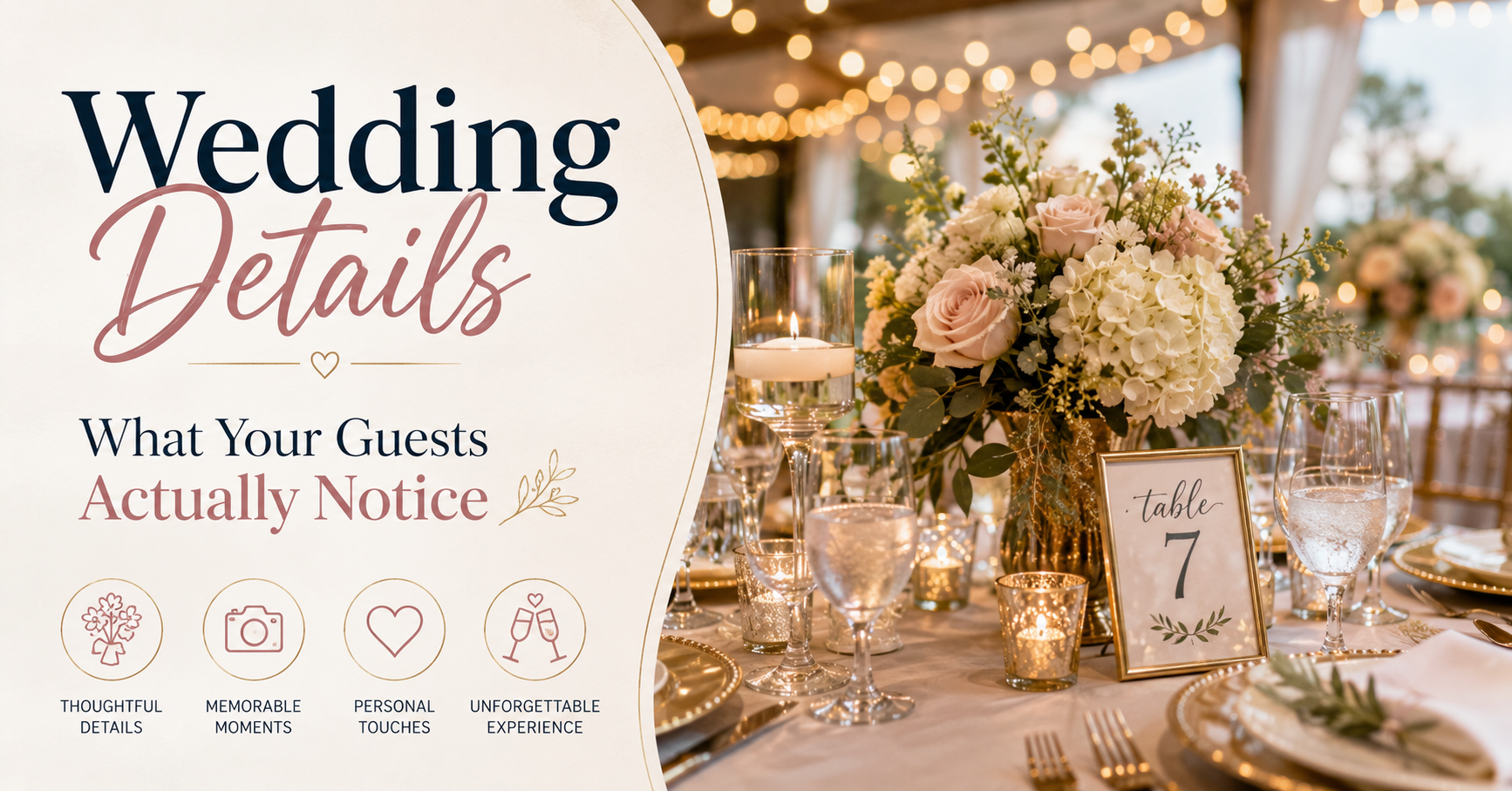
I spent four hours picking a font for my sister’s wedding invitations. Four. I compared serifs against scripts, printed test cards, held them up to the light like I was appraising diamonds. At the reception, I asked twelve different guests what they remembered about the invitation. Not one mentioned the font. Three mentioned that the ceremony started late and they stood in the sun for twenty minutes. That’s the gap between what couples plan for and what guests actually walk away remembering.
Here’s where the two lists diverge and where your energy is better spent.
1. Temperature Before Aesthetics
Nobody has ever complimented a wedding on its ambient air quality. But everybody remembers being too hot or too cold. A gorgeous tented reception in July with no airflow turns into a room full of guests fanning themselves with the program instead of listening to the toasts. Check the venue’s climate plan before you fall in love with the string lights. Fans, shade structures, or simply timing the ceremony for cooler hours does more for guest experience than almost any decor upgrade.
2. How Long They Wait to Eat
This is the single biggest driver of guest mood, and it’s rarely discussed in planning meetings. A cocktail hour that runs an hour and forty-five minutes because photos ran long leaves guests hungry, a little cranky, and reaching for their fourth drink on an empty stomach. Build real buffers into your timeline, and if photos are going to run long, get passed appetizers out earlier. Nobody remembers your signature cocktail name. Everyone remembers being hangry at hour two.
3. Whether They Can Hear Each Other
A DJ or band cranking the volume during dinner feels celebratory to the couple and genuinely painful to the sixty-year-old aunt trying to catch up with her nephew across the table. Guests notice, sharply, when they can’t hold a conversation without shouting. Ask your DJ to keep dinner-hour volume at conversational levels and save the full power for after plates are cleared. This single adjustment changes how “fun” the night feels to more than half your guest list.
4. Not Getting Lost
Nothing chips away at goodwill faster than guests wandering a venue looking for the bathroom, the bar, or the ceremony site itself. Clear, simple signage even a handwritten chalkboard arrow removes friction guests didn’t know they were bracing for. Same goes for parking instructions and shuttle timing sent in advance. It’s not glamorous. It’s also the difference between guests arriving relaxed and guests arriving flustered fifteen minutes into cocktail hour.
5. Where They’re Seated, and Who’s Next to Them
Guests will forgive a lot about a seating chart’s logic if the company at their table is decent. What they won’t forgive is being seated next to a stranger with zero shared interests for a three-hour dinner, or split from the one person they actually came to see. Spend real time on this. It matters more than the runner fabric on the table. If two guests know absolutely nobody else at their table, give them at least one shared thread a mutual friend, a hobby, anything to open with.
6. Small Personal Touches Over Expensive Ones
A handwritten note at each place setting gets remembered longer than an elaborate centerpiece that cost four times as much. Guests notice when something feels made for them specifically a favorite song worked into the set list, a childhood photo on the welcome table, a favor that actually reflects the couple instead of a generic branded item. These cost little and land hard, precisely because they signal effort rather than budget.
7. How the Day Actually Flows
Guests can’t articulate “pacing,” but they feel it. A reception that moves — toasts that don’t run fifteen minutes each, a first dance that doesn’t stall the room, a clear moment when dancing officially starts reads as well-run. One that drags through six separate formalities before anyone gets to the dance floor reads as long, even if the individual moments were lovely. According to The Knot’s 2025 Real Weddings Study, couples increasingly rank making guests feel taken care of above overall spending, which tracks with what guests actually report noticing: not the budget, but the flow.
What to Do Now
Walk your own timeline and ask, for each hour, what a guest is actually doing and feeling during it not what they’re looking at. Fix the two or three spots where the answer is “standing around, hot, hungry, or lost” before spending another hour on a font choice nobody will mention at the reception. That reallocation, more than any single upgrade, is what makes a wedding feel generous instead of just expensive.